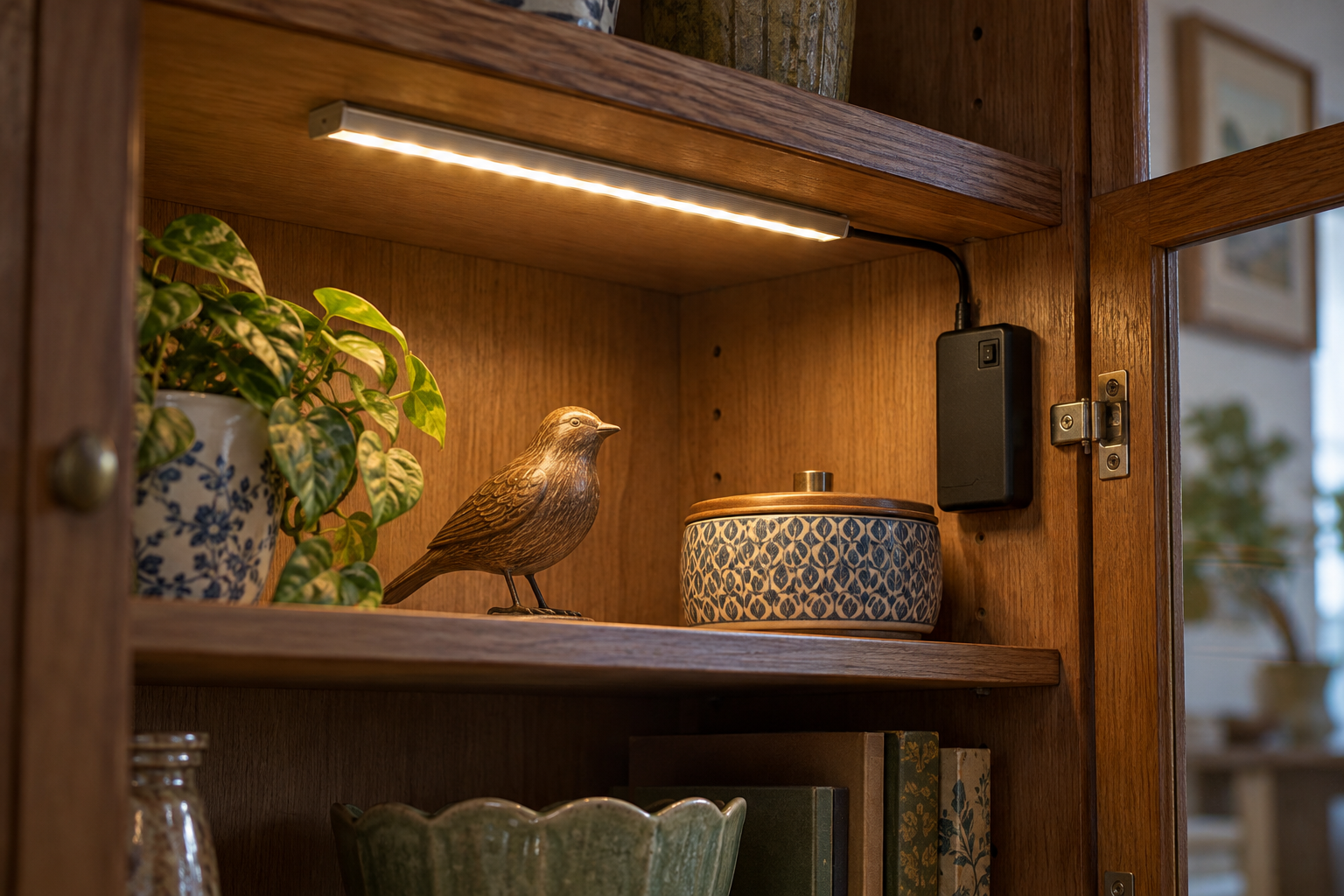
Yes, a battery can power a compatible LED strip, but the strip, pack, connections and controls must form a supported system. It works most sensibly for a short light used intermittently where charging or cell replacement is easy. For a long run used every evening, plan a proper supply rather than assuming a larger battery solves every problem.
I would begin with the usable light and daily operating time, then check the battery arrangement. A kit’s advertised “hours” is not a guarantee for another strip or brightness setting.
Match the output before the plug
| Check | What must match |
|---|---|
| Voltage | Pack or converter output within the strip’s stated operating range |
| Output capacity | Supply, controller, cable and connector capacity for the full load |
| Polarity and channels | Exact positive/negative arrangement or multi-channel wiring |
| Regulation | Acceptable output as the battery discharges, not only its initial voltage |
| Protection | The maker’s required overcurrent, short-circuit and battery protection |
| Location | Ratings for the pack, switch, joints and strip in the actual environment |
A round barrel plug may fit while its polarity or voltage is wrong. A USB connection also does not promise that a power bank supplies the voltage and continuous power your strip requires. Negotiated USB modes and conversion electronics need a supported design, not a passive lead chosen by appearance.
Estimate runtime with energy, then state the uncertainty
Use the battery maker’s usable output-energy figure when available. At the same specified energy basis, an ideal runtime is usable watt-hours ÷ load watts. If only nominal capacity is given, nominal Wh = nominal voltage × Ah. That is not necessarily energy available to the strip after conversion, cutoff, aging and operating conditions.
For an invented example, a nominal 12 V, 2 Ah pack represents 24 Wh. A 6 W load gives an ideal 4 hours. If you explicitly assume 80% of that energy reaches the load, the estimate becomes 3.2 hours. The 80% is a calculation assumption, not a measured efficiency or a default for a battery type.
Include controller and converter consumption in the load. Do not compare a power bank’s cell-rated mAh directly with a strip’s input current at a different voltage. Ask for output-energy data and record the brightness at which runtime is specified. A strip can remain faintly lit after its useful output has ended.
Choose a serviceable arrangement
A purpose-built replaceable-cell kit can suit a small dry cabinet if its instructions cover the intended use. Use the specified cell type and replacement procedure; do not mix unsuitable cells or try to recharge a primary cell. A rechargeable system needs its supported pack, charging method and protection together.
CPSC emphasizes testing batteries with the intended product and charger as a system. Follow the original manufacturer’s instructions and do not assemble or modify lithium-ion packs. Keep batteries accessible for inspection and service, away from trapped heat, physical damage and children.
Plan the low-voltage connection without improvising a circuit
Start from the supplied connection diagram. A typical supported arrangement puts the protected pack output through the maker’s switch/controller and then to the matching strip terminals. The exact order, protection, converter and connectors depend on that system. This is not a wiring prescription for bare cells or an unknown pack.
Disconnect the pack before connecting, cutting or servicing the strip. Use supported, insulated connections with strain relief; do not leave conductors loose behind timber or fabric. Secure the pack so it cannot pull on the strip lead. The enclosure rating of the strip alone does not make the battery and joints suitable outdoors.
Know when to stop or change the power plan
Use a properly installed mains-powered LED supply when the required continuous output or service burden makes battery operation impractical. Have an electrician handle new outlets, hardwired supplies, concealed electrical work or uncertain building wiring. Battery accent lighting is not a substitute for required emergency or escape lighting.
Stop using or charging a damaged, swollen, unusually hot or leaking battery. Do not handle a hot or unstable pack; follow the maker’s disposal advice. If it smokes or burns, move away, evacuate and contact emergency services. Charge with the supported charger on a suitable surface where heat can dissipate, following the manufacturer’s instructions.
Next steps
Work out the strip load · Understand usable-light runtime · Plan a supported installation