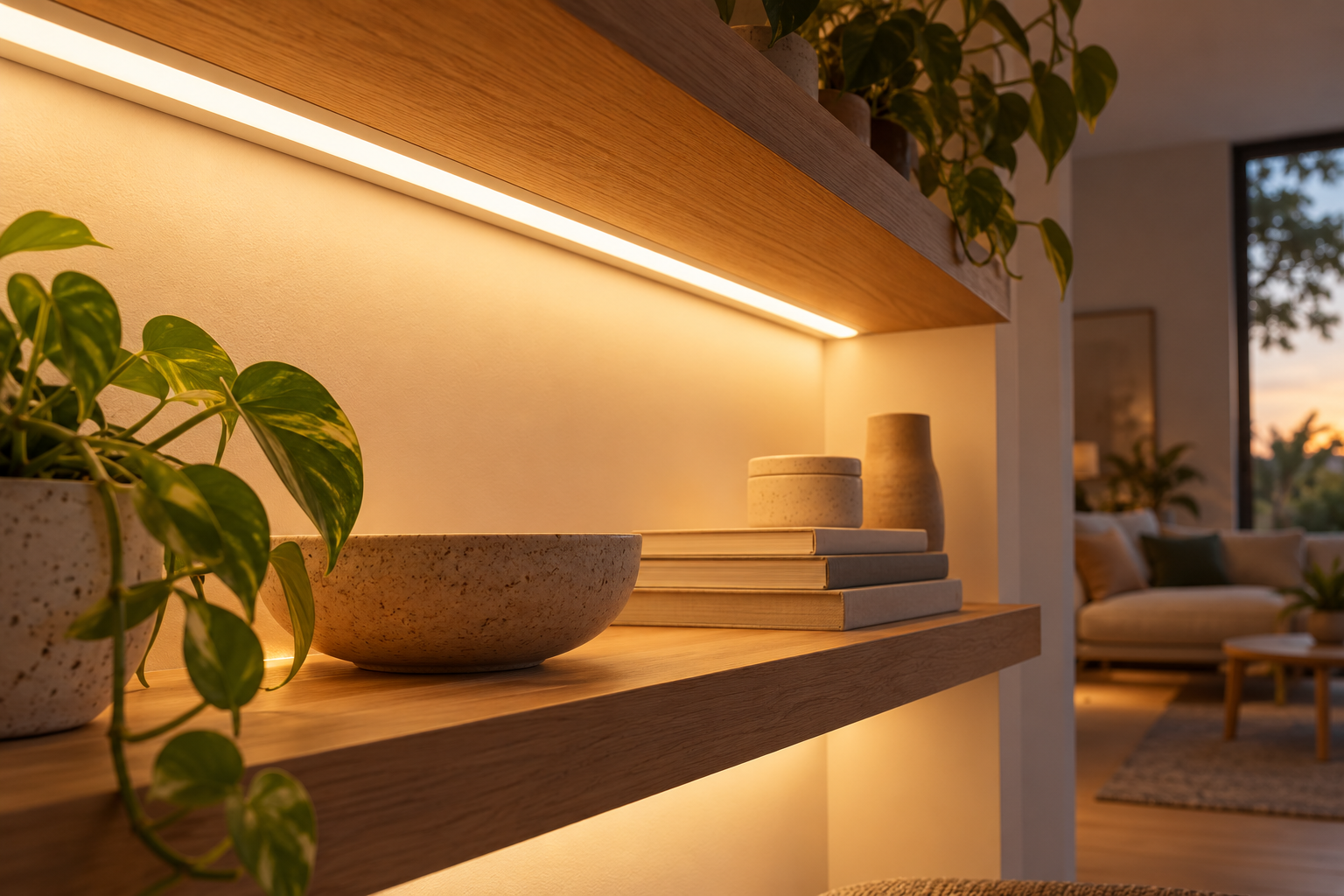
A diffuser can make an LED strip look less like a row of individual points, but no cover makes every strip perfectly even. The result depends on the spacing of the LEDs, the distance to the cover, the material and the viewing angle. Start with a short sample and compare the complete cost, including the channel and fixings, before buying for the whole room.
For most permanent installations, a diffuser made for the chosen LED profile is the most straightforward starting point. It has a defined fit, a way to mount and remove it, and manufacturer information to check against the strip. A cheaper improvised material is not necessarily a good value if its heat behaviour, mounting and future replacement are unknown.
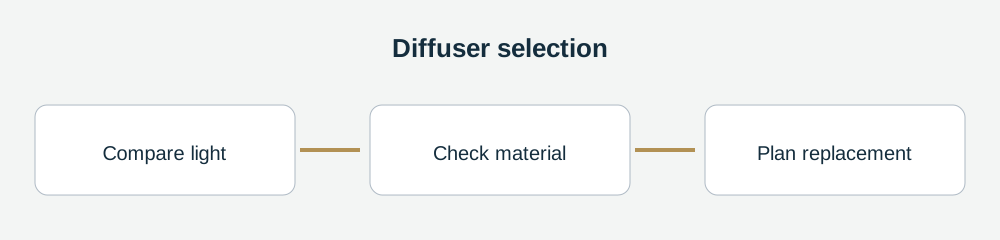
Start with the view and the complete assembly
Check whether the discomfort comes from seeing the LEDs directly or from their reflection on a shiny surface. Temporarily hold a piece of card between your eyes and the light, without touching or enclosing the strip, to compare the view. Moving or shielding the source may solve the problem without buying a filter. Choose a compatible dimmer when adjustment is needed.
A cover can soften visible dots but also reduce useful light. Compare a sample of the exact strip and cover in place; the channel selection guide explains the depth and layering trade-offs.
Compare the practical options
A fitted channel and cover gives the strip support and a removable surface designed to match the profile. Aluminium profiles can also provide a heat path when used with a suitable strip. Check internal width, connector clearance, fixing method and the thermal instructions. Ask for cover lengths and whether replacements can be purchased later.
A denser strip or a COB strip can reduce the spacing between emitting points. It is useful when the existing channel cannot be made deeper, but changing the strip also means checking voltage, load, control compatibility and cut positions. An addressable COB strip exists, so choosing a more continuous-looking light does not always mean giving up animation. Nevertheless, pixel groups and supported control protocols vary by model; check the WLED selection guide when animated effects matter.
A different mounting position can be cheaper than replacing the whole system. If the source is hidden and illuminates a wall or ceiling rather than being viewed directly, it may produce a smoother effect. Make sure the new position still illuminates the intended area and follows the strip’s mounting instructions. Moving the strip does not remove the need for a suitable support and safe wiring.
There is no single cheapest good option for every installation. A cover can be inexpensive by itself but require a matching profile and shipping. A new strip may be attractive until the driver, connectors and labour are included. Ask for current prices and compare the complete installed system.
Treat improvised materials cautiously
Ordinary packaging foam is not a recommended LED diffuser. Public information about the heat and fire performance of packaging foam used beside a particular LED strip is insufficient to establish it as a suitable lighting component. Some foam materials, including expanded polystyrene, are combustible and should be kept away from heat sources. Do not infer that a particular combination is safe merely because it appears to work during a short demonstration.
Similarly, ordinary white tape or a silicone cord is not supported here by product-specific evidence about heat ageing as a diffuser. Their appearance in a photograph does not establish suitability for continuous use. If a material is marketed for lighting, obtain its exact temperature rating, mounting instructions and compatibility with the strip and profile. Confirm how it can be removed and replaced if it discolours or becomes damaged; do not assign a lifespan to an unspecified material.
A very small number of personal examples cannot establish long-term safety or prove that a homemade cover will work for another strip. Brightness, temperature, enclosure and power differ. Choose materials that the lighting or profile manufacturer identifies as suitable for the application, and use the complete product in the location for which it is rated.
Test the actual combination
Order a short length of the preferred strip, profile and cover where possible. Check that the strip and connectors fit without being crushed, that the cover can be removed and that the profile can be attached securely. Follow the supplier’s instructions for installation, including any required mounting surface and clearances.
Place the sample where it will be used. View it directly and in reflections from the normal positions in the room. Compare full brightness and the lower settings you expect to use. If the strip changes colour, check several colours and the white channel. Some effects or colours may make pixel groups more obvious than a static white setting.
Photograph the sample for comparison, but keep the camera’s exposure consistent. A phone may automatically brighten shadows or suppress highlights, making one option look smoother or brighter than it does in person. Use the photograph as a record, not a measurement of the cover’s transmission or a safety test. A short trial also cannot establish long-term ageing.
If you need more light, compare a less opaque cover, a denser compatible strip, more depth, another fixture or a different mounting position. Keep the strip within its rated conditions. Higher output can increase heat and power demand; verify the full combination before replacing components.
Plan for power and replacement
Check that the strip, driver, control and mounting system are compatible and follow the manufacturers’ instructions. Long runs need a power plan; see the channel selection guide for planning considerations. Ask a qualified electrician about mains wiring or any connection you cannot assess safely.
Keep the strip and driver model numbers and check whether a replacement cover can be bought and removed without damaging the installation.
Compare the complete purchase
For a fair comparison, price the same finished length and include the profile, cover, end caps, fixings, compatible connectors and any delivery or installation charges. A single inexpensive cover may not fit a profile you already own. Ask whether the seller offers a short sample and whether replacement covers remain available. Current prices and availability should be checked at the time of ordering.
Keep the product instructions and model numbers after installation. If the cover becomes damaged, these records help you find a compatible replacement without guessing its dimensions or material. A removable cover also lets you inspect the strip and clean the outside according to the maker’s instructions.
Five questions before choosing a diffuser
- What temperature and mounting conditions does the strip manufacturer specify?
- Is the proposed cover or material intended and rated for this lighting application?
- How much useful light remains with the cover in place?
- Can the cover and strip be removed and replaced without damaging the installation?
- Does the sample look suitably even in person, at the actual viewing distance and brightness?
Choose the least expensive complete solution that answers those questions for your space. A fitted cover, a better-positioned strip or a different strip density may each be the economical choice in a different room.
Questions & discussion
Share a question or a useful experience about this guide. Comments appear immediately. Your name and comment are public. Email is optional and stays private; reply emails are not enabled yet. Comment privacy.